Stop Loss and Take Profit Explained, and How to Size Them
A stop loss is the most you are willing to lose in a session. A take profit is the gain you are aiming for. Setting both before you start is one of the simplest ways to keep a bot inside your plan.
Last updated:
What they mean
Deriv defines a stop loss as a risk management feature that lets you set the maximum level of potential loss you are willing to tolerate, and a take profit as a feature that lets you set your targeted level of profit.
They apply across a session
In AI Binary Bots, stop loss and take profit work across a whole session, not on a single trade. The stop loss caps what a session can lose in total, and the take profit sets the total profit you are aiming for.
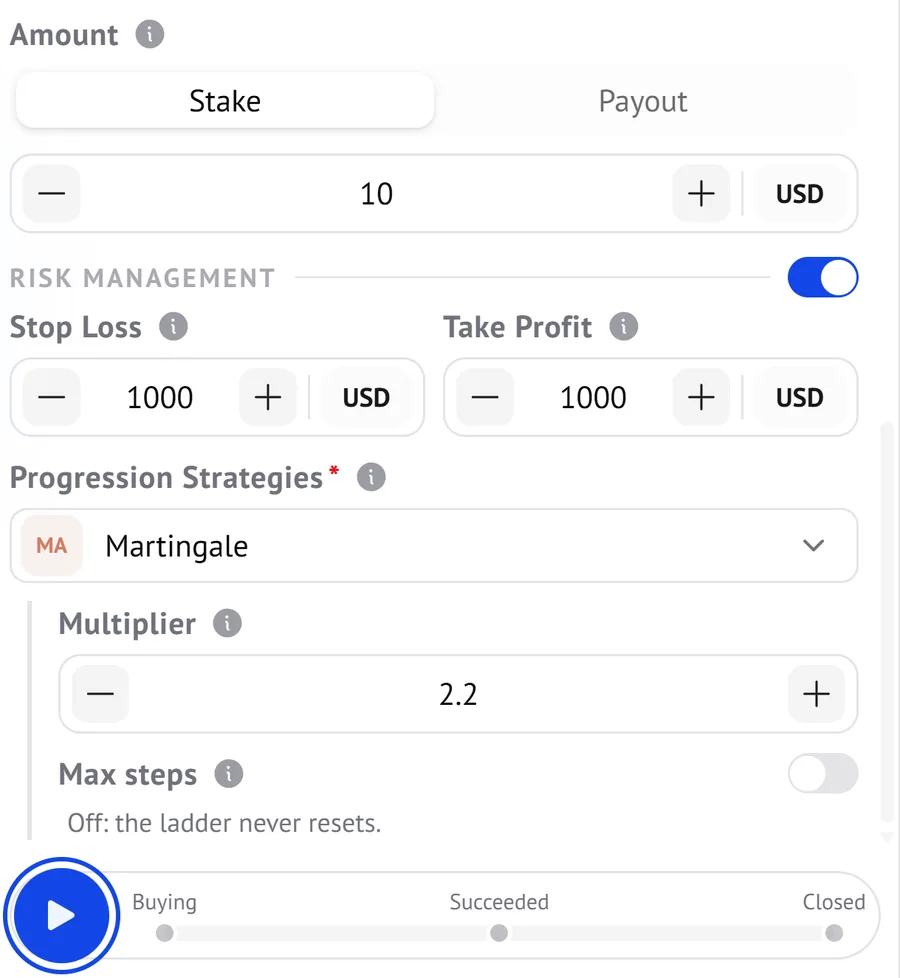
How to set them in the app
- In the Trading Panel, find Risk Management below Amount and switch it on.
- Enter a Stop Loss amount in your account currency, using the field or the plus and minus buttons. This is the most the session can lose.
- Enter a Take Profit amount in the same way. This is the profit you are aiming for in the session.
- Set up your progression strategy, then press play.
A practical way to size them
There is no perfect number, and the right values depend on your bankroll and how much risk you accept. These are general starting points for thinking it through, not advice:
- Start from your bankroll. Decide the share of your balance you can afford to lose in one session. Many traders pick a small percentage. Your stop loss should not exceed it.
- Make the stop loss fit your stake and strategy. Because it covers the whole session, a stake that is tiny compared with your stop loss lets the bot place many losing trades before the limit is reached.
- Use a take profit to lock in goals. A session take profit that is very far away may never be reached. A very close one ends sessions early.
- Check the risk-reward ratio. Deriv describes it as potential profit relative to potential loss. A stop loss much larger than your take profit means you risk a lot for a small gain.
| Choice | Stop loss | Take profit | Risk-reward |
|---|---|---|---|
| Cautious | 30 USD (3%) | 60 USD (6%) | 1 : 2 |
| Balanced | 50 USD (5%) | 75 USD (7.5%) | 1 : 1.5 |
| Wide | 100 USD (10%) | 100 USD (10%) | 1 : 1 |
Example: a 1,000 USD bankroll. Illustrative examples to show the arithmetic, not recommendations.
Stop loss and progression strategies
Strategies that raise your stake after a loss can reach large amounts quickly. With a 10 USD starting stake and a 2.2 multiplier, six losses in a row means 936.50 USD staked in total, and a seventh would take the total past 2,000 USD. A session stop loss of 1,000 USD sits just above that 936.50 USD, which leaves only 63.50 USD of room before the limit, while the seventh stake would be 1,133.80 USD. Choose your limits and your strategy settings together. See how Martingale works and the strategy comparison.
Limits reduce risk, they do not remove it
A stop loss limits how much a session can lose, but it cannot make a losing approach profitable. Test your limits on a demo account first.
Practise on a Deriv demo account before you use real money.
Get StartedFrequently asked questions
- What is a stop loss?
- A risk management setting for the maximum loss you are willing to tolerate. In AI Binary Bots it applies across a session, not to a single trade.
- What is a take profit?
- A setting for the profit level you are aiming for across a session, so you can stop once you reach your target.
- How big should my stop loss be?
- That is your decision and depends on your bankroll and risk tolerance. Keep it small compared with your balance, and make sure it suits your stake and staking strategy.
Keep reading
- How Martingale works on DerivWhat a progression strategy does to your stakes, with a worked example.
- Which staking strategy should I use?Compare all 15 strategies side by side with links to each guide.
- Trade analytics explainedTrade analytics summarises your settled trades in one view. This guide explains each metric and uses a real example where a 54% win rate still lost money.
Sources
Risk warning: Trading binary options involves a high level of risk and you could lose your entire stake. Only trade with money you can afford to lose. This page is educational and is not financial advice.